PART 2 The moment he opened the envelope, the noise around the gate seemed to fade.
- LongVo
- July 1, 2026
PART 2
The moment he opened the envelope, the noise around the gate seemed to fade.
Not because it got quieter.
But because my brother stopped hearing anything else.
I watched from the security monitor inside the farmhouse as he unfolded the first page.
His smile was still there—barely.
Then it twitched.
Then it tightened.
Then it started to vanish altogether.
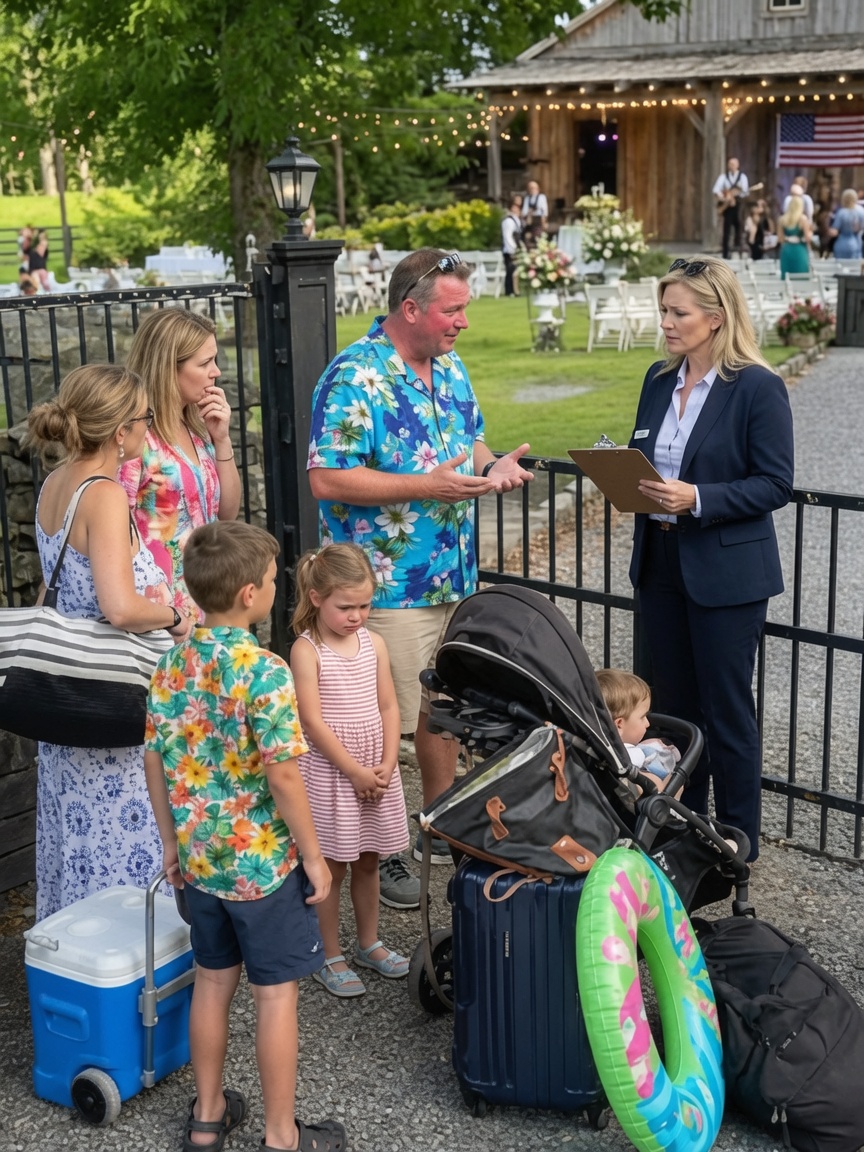
The estate manager stood beside him, calm as ever, hands behind his back.
“Is there a problem?” my brother asked, still trying to laugh it off.
But his voice didn’t land the same way anymore.
Because something had shifted in his posture.
Confidence doesn’t usually disappear all at once. It leaks out in stages.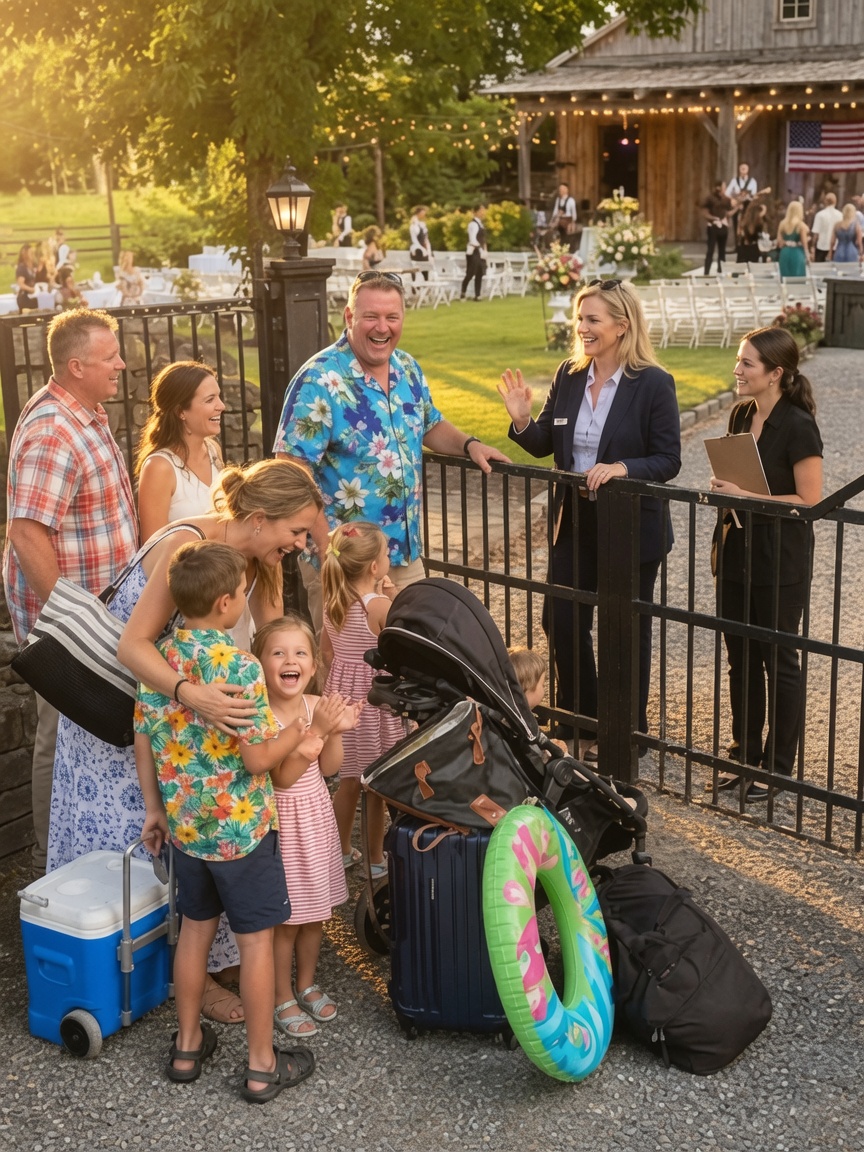
First the shoulders.
Then the eyes.
Then the way someone stops looking at people directly.
“I think there’s been a mistake,” my brother said, holding up the paper like it might correct itself. “This says restricted access for private event scheduling.”
The manager nodded once.
“No mistake.”
Behind him, one of the kids ran toward the gate again, tugging at the chain link. A cooler tipped over. Ice spilled across the gravel like it belonged there.
My brother didn’t notice anymore.
He was reading the second page.
And that’s when his expression changed completely.
Because it wasn’t just a rental agreement.
It wasn’t just a wedding booking.
It was enforcement terms.
Security authorization. Trespass conditions. Liability clauses. And one line highlighted in clean, printed ink:
Any unauthorized entry will result in immediate removal by security and cancellation of event access without refund or negotiation.
He looked up.
Slowly.
Like he was trying to find the version of me that would step out and fix this.
That version didn’t come.
Instead, the estate manager finally said, “We asked for your name earlier.”
My brother gave a short laugh. “Yeah. It’s—come on. You know me. I’m her brother.”
“That’s not what I asked,” the manager replied evenly.
A pause.
“I asked for your legal name.”
That’s when the shift became visible to everyone.
Even the kids stopped running.
Even the woman with the pool float hesitated.
My brother swallowed. “Why does that matter?”
The manager tapped the tablet in his hand.
“Because your name appears on a previous trespass warning issued last year after unauthorized use of the property during a booked event.”
Silence.
Sharp.
Clean.
Unforgiving.
My brother blinked. “That was… that was just a misunderstanding.”
The manager nodded again, almost politely.
“And it is the reason you were placed on a restricted access list.”
Now the word restricted finally landed.
Not as a suggestion.
As a boundary.
One he had already crossed before.
Behind him, one of the guests whispered, “We should probably go…”
That was the first crack.
The first moment the group stopped feeling like a group.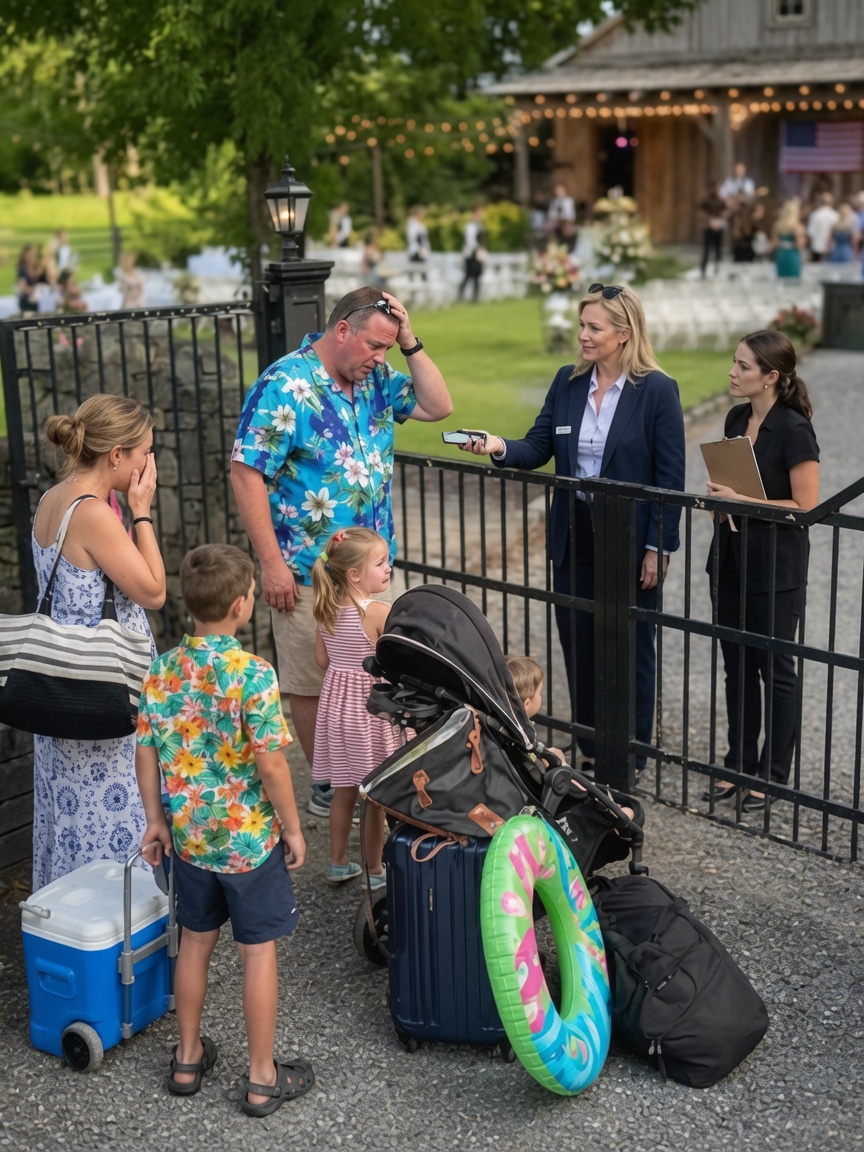
My brother turned slightly, lowering his voice. “Okay, listen. We didn’t know there was a wedding today. We can just stay on the lawn, keep to ourselves, no problem.”
The manager didn’t even look away from his tablet.
“There is no permission for stay-on-site access today.”
A beat.
Then, softer:
“You need to leave.”
That was it.
No argument. No escalation. Just reality stated plainly enough that it couldn’t be twisted.
My brother laughed again—but it came out wrong this time.
“We’re family,” he said. “She wouldn’t do this. She’s not like that.”
And for the first time, I stepped outside.
Not rushing.
Not emotional.
Just present.
The kind of presence that doesn’t ask for permission anymore.
The gate area went quiet when they saw me.
My brother straightened immediately, relief flashing across his face like a reflex.
“There you are,” he said quickly. “Tell them this is ridiculous. We’re not trying to cause trouble.”
I looked at him for a long moment.
Then I looked at the coolers. The bags. The kids. The assumption that space equals entitlement.
And I said something I never thought I would have to say out loud.
“This is a wedding venue today.”
He frowned. “Yeah, but it’s Grandma’s farm.”
“No,” I said.
A pause.
Then I repeated it more clearly.
“It’s a contracted property under event use. You were notified.”
That’s when his expression finally broke.
Not anger.
Not confusion.
Something worse.
Realization that he had walked into a situation where his usual tone didn’t work anymore.
He stepped closer. “Come on. Don’t do this in front of everyone.”
But I didn’t move.
“I’m not doing anything,” I said. “You are.”
The manager quietly raised a hand toward security on the radio.
And that small motion—barely visible—changed everything.
Because now it wasn’t a conversation anymore.
It was a procedure.
My brother looked around, like maybe someone would still laugh and turn this into a misunderstanding.
No one did.
Even the kids had gone still.
And in that silence, I saw it clearly:
For the first time, he wasn’t standing on family land expecting forgiveness.
He was standing on rented ground where rules actually mattered.
The security gate clicked once.
And the estate manager said calmly, “You have five minutes to clear the driveway.”
My brother stared at me like I had personally rewritten the world.
But the truth was simpler than that.
I had just stopped letting him treat mine like it didn’t exist.